Commercial Roof Repair vs Replacement: How Etobicoke Facility Managers Should Decide
Etobicoke facility managers: learn exactly when to repair vs replace your commercial flat roof, with real cost ranges and a free inspection offer.
- Jun 14
If you're standing on a roof right now with a contractor pointing at a wet spot, this post is for you. Not for someone three years out from a capital project doing general research — that's a different read. This is for Etobicoke and Toronto facility managers, property managers, and building owners with an active roof issue and a number they need to bring to ownership soon.
The short version: repair, partial replacement, and full replacement are three legitimately different answers, and the right one depends on what's actually happening under your membrane — not on which contractor showed up first. We do all three across the GTA, and we'd rather tell you which one your roof needs than sell you the bigger job by default. That's the rest of this post.
The 60-Second Verdict — Repair, Partial, or Full
Before the detail:
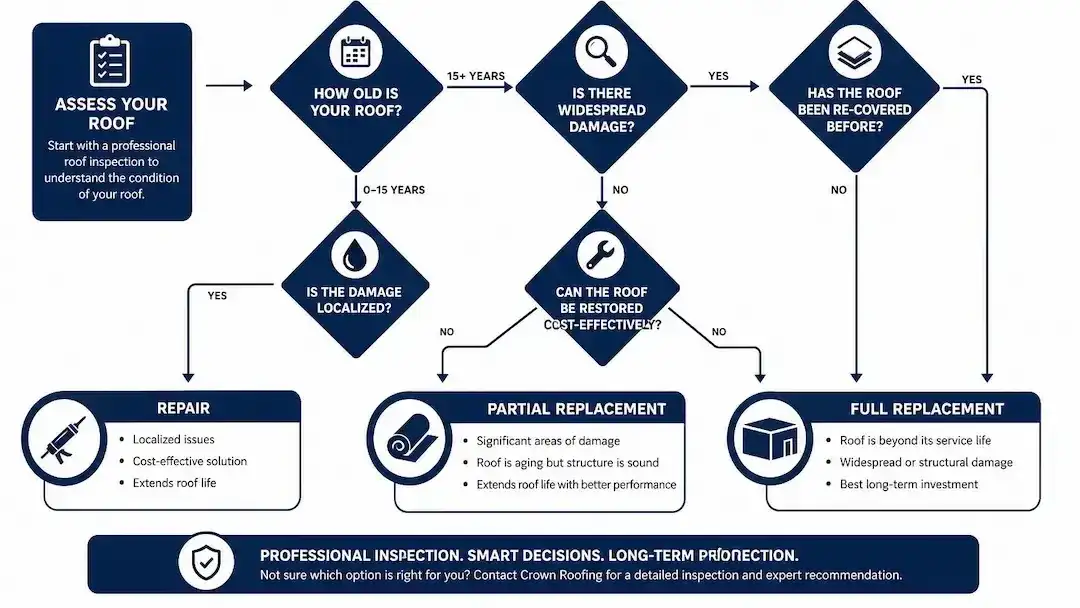
- Isolated damage, under 25% of the roof, dry substrate underneath: Repair is the right call. A full replacement here is an upsell, not a fix.
- One defined section failing while the rest of the roof is mid-life and sound: Partial replacement. Isolate the bad zone, leave the good roof alone.
- Wet insulation, repeat failures in the same area, or a membrane past its service life: Full replacement is the only answer that doesn't cost you twice.
That's the skeleton. The rest of this post is the muscle.
Why This Decision Is Harder in Etobicoke's Climate
Most "repair vs replace" guides online are written generically, with no climate context at all. Toronto's freeze-thaw cycle changes how fast a small problem becomes a big one, which is exactly why the threshold matters more here than it does in a milder market.
60+ freeze-thaw cycles a year, and what that does to a marginal repair
A Toronto commercial roof goes through roughly 60 freeze-thaw cycles annually. Each one is water expanding in a seam, a flashing detail, or a patch edge, then contracting. A repair that would hold indefinitely in a stable climate gets stress-tested 60 times a year here. That's part of why we check substrate moisture before quoting any repair — a patch over wet insulation in a Toronto winter fails faster than the same patch would somewhere milder.
Snow load and ponding water — the variable that decides more than the membrane does
The biggest predictor of whether a repair holds isn't the patch material. It's drainage. A roof with adequate slope and clear drains can carry a repair for years. A roof with standing water sitting on it every spring turns even a well-executed repair into a temporary measure. If your roof has known ponding issues, that's a conversation that needs to happen before you decide between repair and replacement — not after.
Repair: When It's the Honest Answer
What a targeted repair actually involves
A flat roof repair isolates the failed area — a seam, a penetration, a section of membrane — and replaces or reseals it with compatible material. Done correctly, it doesn't touch the rest of the roof. The whole premise depends on the rest of the roof being sound, which is what the checks below confirm.
Repair pros: cost, speed, no disruption to roof areas that don't need it
- Lowest cost of the three options when conditions support it — usually resolved in a single service visit.
- Fast turnaround. No mobilization for a full tear-off, no extended access disruption for tenants below.
- Doesn't touch roof life you haven't used yet. If 80% of your roof has years left, repair lets you keep that value instead of resetting the clock early.
Repair cons: it only works under specific conditions
Repair stops being the honest answer the moment any of these are true: damage covers more than roughly 25% of the roof, the substrate or insulation underneath is wet, the roof is already past 50% of its expected service life, or this is the third or fourth repair call to the same area within two years. Outside those conditions, repair becomes a way to delay an expense, not avoid it — see the cost section below for what that delay actually costs.
Best-fit scenarios for repair
- Single failed seam, penetration, or flashing detail with no wider pattern of failure
- Roof under 8–10 years old on a 15–20 year system, with one isolated issue
- Confirmed-dry substrate via moisture scan
- Same membrane system throughout — no patchwork of incompatible prior repairs
Partial Replacement: The Option Most Facility Managers Don't Know Exists
How it works
Partial replacement fully tears off and re-membranes one defined section of the roof — a distinct drainage zone, an older addition, a zone that's failed past economical repair — while leaving the remaining sections, which are still mid-life and performing, untouched. It's a full replacement scoped to the part of the roof that actually needs it.
Partial replacement pros: targeted spend, no wasted service life
- You're not paying to replace roof area that's still earning its keep. If one section failed early due to a one-off issue — a deck problem, a drainage defect, a bad original installation — partial replacement fixes that section without writing off the rest of the roof's remaining life.
- Resets the clock on the part that needed it, with proper transition detailing tying old and new sections together.
Partial replacement cons: transition risk, and the trap of doing it repeatedly
The transition detail between old and new sections is the entire game — done poorly, it becomes the next leak point. And partial replacement only makes financial sense as a one-time, defined-zone fix. A facility manager doing a "partial" every two years on a different section of the same roof isn't saving money against full replacement — they're financing the same full replacement in expensive installments, with added transition-detail risk at every boundary.
Best-fit scenarios for partial replacement
- Roofs with distinct sections — an older original area plus a newer addition, or separate drainage zones
- One section has failed clearly past repair while the rest is genuinely mid-life
- A single root cause (bad original install, isolated deck issue) confined to one zone
Full Replacement: When It's the Only Honest Answer
What pushes a roof past the repair-or-partial threshold
Full replacement is the right call — not the upsell, the actually correct call — when a moisture survey shows widespread saturated insulation, when the same roof has needed repair three or more times in 24 months, when the membrane is chalking, brittle, or shrinking at the edges, or when the deck substrate itself has deteriorated. None of those conditions get fixed by a patch. They get fixed by a patch that fails again in a different spot.
Full replacement pros: resets everything, including the warranty clock
- Buys 15–20+ years of service life instead of an unknown number of future repair calls on a roof that's already told you it's failing.
- Comes with a real workmanship warranty — Crown offers up to 15 years — instead of a patch-by-patch guess.
- Ends the cumulative-cost problem. Stops the slow bleed of repeat repair invoices that, added up, frequently exceed the replacement cost anyway.
Full replacement cons: the largest single capital outlay
There's no way around it — full replacement is the biggest line item of the three. It's also, on a roof that's already showing the conditions above, the option that actually stops the spending rather than continuing it in smaller, more frequent installments.
Best-fit scenarios for full replacement
- Moisture survey shows widespread wet insulation, not an isolated pocket
- Three-plus repair callbacks to the same roof within two years
- Membrane at or past expected service life, showing chalking or brittleness roof-wide
- Confirmed deck/substrate damage from sustained moisture exposure
Side-by-Side Comparison Table
Cost tier, timeline, what it resets, and Etobicoke suitability
Repair
Partial Replacement
Full Replacement
2026 GTA cost tier
Lowest — single service visit
Mid — priced per sq ft of affected zone
Highest — priced per sq ft, full roof
Typical turnaround
Same-day to a few days
Days to roughly 1–2 weeks
1–4+ weeks depending on size/access
What it resets
Nothing — extends current system
Service life of the replaced zone only
Entire roof's service life and warranty
Substrate requirement
Must be dry
Dry in remaining sections; new zone rebuilt
N/A — full rebuild
Workmanship warranty
Limited to repaired area
Applies to replaced zone
Up to 15 years, full roof
Best fit
Isolated, dry, early-life roof
Sectioned roofs, one bad zone
Wet insulation, repeat failures, end-of-life
No option wins every column. That's the point — the right one depends on what's actually happening under your membrane.
Decision Framework for Etobicoke Facility Managers
Here's how to work through it without a sales rep steering the outcome:
Start with the moisture survey, not the visual damage. What you can see on the surface tells you where to look. What's underneath tells you what to do. A roof that looks rough on top with dry insulation underneath is often a repair. A roof that looks fine on top with wet insulation underneath is a replacement waiting to announce itself.
Then count the repair calls. One callback in two years is normal wear. Three or more to the same area means the roof has made the decision for you — the only honest framing left is full or partial replacement, not another patch.
Check whether the roof has distinct sections. If it does, and only one section is failing, partial replacement is worth pricing out separately rather than defaulting straight to a full tear-off quote.
Get the cumulative cost, not just the line item. A single repair quote always looks smaller than a replacement quote. Add up what you've actually spent on that roof over the last 24 months before comparing — see the cost-tier table above for what each path actually runs.
What Etobicoke Roofing Contractors Won't Tell You About This Decision
A lot of contractors default to whichever quote is easiest to write, not whichever is right for your roof. A repair-only contractor will keep quoting repairs. A replacement-focused contractor will lean toward full tear-offs. Neither is necessarily dishonest — it's just where their default sits. The fix is working with a contractor who genuinely does all three and will say so when repair is enough.
"Cheap repair now" and "low-cost long-term" are not the same claim. We've watched roofs run up four or five repair invoices over two years that, added together, land at two to three times what a partial or full replacement would have cost at the start — with zero additional service life to show for it, because the roof still needed replacing at the end of it.
Your insurance policy may already be telling you something. Some commercial property policies carry roof-age or roof-condition clauses that adjust coverage or premiums. Worth confirming with your broker before finalizing a repair-vs-replace decision, especially on a roof approaching the end of its expected life.
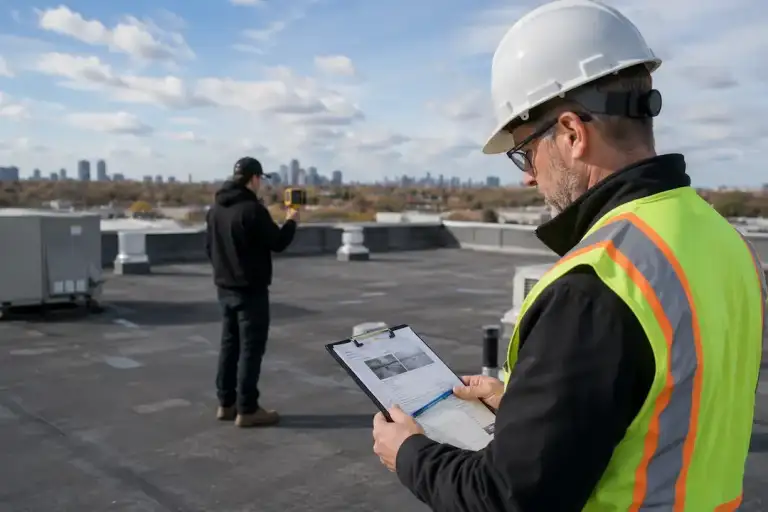
Documentation is what makes a capital request land. A moisture survey, infrared scan, and dated photos turn "the roof needs work" into a capital reserve line item a board will actually approve. We include this documentation with every inspection for exactly that reason.
FAQ
Can you repair part of a flat roof?
Yes. Partial repair is appropriate when damage is contained to a defined section — typically under 25% of total roof area — and the substrate and insulation beneath that section are dry. Crown assesses substrate condition before quoting any repair to confirm a partial fix will actually hold rather than mask a larger problem.
How much does it cost to have a flat roof repair?
Cost depends on the size and accessibility of the damaged area, the roofing system involved, and whether the substrate is dry or compromised. Isolated spot repairs are typically the most affordable tier of roofing work; larger section repairs with multiple penetrations or recurring issues cost more. A free on-site inspection is the only reliable way to get an accurate number for your specific roof.
How much would it cost to repair a flat roof?
Pricing scales with the extent of damage, not just the square footage of the roof — a small but deep problem (wet insulation, deteriorated decking) can cost more to address than a larger but shallow one (a single failed seam). Crown provides itemized, building-specific quotes after inspection rather than flat per-square-foot estimates, since those numbers vary too much by roof condition to be meaningful without seeing the roof.
What is the cheapest way to replace a flat roof?
When full replacement is genuinely necessary, partial replacement of only the failed section (rather than the entire roof) is typically the lowest-cost path — provided the remaining roof area is still within its service life and the transition detail between old and new sections is installed correctly. Where damage is roof-wide, a single-ply system like PVC or TPO often offers a lower long-term cost than older built-up roofing, due to lighter material weight, faster installation, and longer typical service life.
Ready to Find Out Which Path Your Roof Actually Needs?
Crown does honest repair-vs-replace assessments across Etobicoke and the GTA. If a repair will hold, we'll tell you. If it won't, we'll show you why.
Book a free roof inspection or call (416) 744-7788.
Cost ranges and condition thresholds in this article reflect Crown Industrial Roofing's project experience and 2026 GTA pricing. Every roof is different. Always request a written, itemized assessment from a licensed roofing contractor before making a capital decision.
Related Reading
- Flat Roof Repair in Toronto
- B.U.R. Replacement Services
- Free Spring/Fall Roof Inspection
- What Causes Flat Roof Damage in Toronto's Climate (verify live before publish — see corrections log)
- Crown's Etobicoke Flat Roofing Service
Recent Posts
Book your free roofing inspection
Protect your building with confidence. Our team responds across Toronto and the GTA — and our emergency line runs 24/7.