Does Insurance Cover Commercial Roof Replacement in Ontario? (And Why Roof Age Decides the Answer)
Does insurance cover commercial roof replacement in Ontario? Roof age, ACV clauses, and non-renewals decide the answer. Here's how to stay covered before your next renewal.
- Jun 22
The letter rarely says "your roof." It says your premium is going up 18%, or that your renewal now carries a "roof surfacing — actual cash value" endorsement, or — in the worst cases — that the carrier has decided not to offer renewal terms at all. Property managers across the GTA have been opening more of these letters lately, and the reason sitting underneath most of them is the same: the roof crossed an age the underwriter cares about, and nobody flagged it in time.
Roof age has quietly become one of the biggest levers in commercial property underwriting. It moves your premium, it changes how a claim gets paid, and past a certain point it can decide whether you get a policy at all. The frustrating part is that none of this shows up as a leak. By the time water is dripping onto a tenant's inventory, the insurance problem is already a year or two old.
So does insurance cover roof replacement — or not?
Start with the question property managers actually ask: does insurance cover roof replacement? For a sudden, accidental, insured event — a windstorm, fire, a fallen tree — the answer is usually yes. For age, gradual wear, and slow leaks, the answer is increasingly no. The line between those two outcomes is drawn almost entirely by your roof's age and its documented condition, which is why a 12-year-old roof and a 22-year-old roof can get completely different answers to the identical claim.
There's no single birthday where a commercial flat roof becomes uninsurable. What underwriters actually react to is a combination of age, membrane type, and — most importantly — documented condition. That said, the pattern across Ontario carriers is consistent enough to plan around.
Premium pressure tends to start around the 15-year mark. That's roughly when many insurers begin treating an older roof as a depreciating liability rather than a fresh asset, and it's often the point where coverage quietly shifts from replacement cost to actual cash value. The bigger jumps — stricter conditions, mandatory inspections, or outright non-renewal — cluster once a roof passes 20 years. Materials buy you different amounts of runway, and a roof in visibly good, documented condition is treated very differently from one with no paper trail at all.
So if you're managing a building with a roof somewhere in its late teens, you're not in crisis. You're in the window where decisions are cheap and options are still open. Wait two more years and both of those things change.
The clause that costs you the most isn't the premium — it's ACV
Most owners watch the premium line. The line that actually hurts at claim time is whether your roof is insured for replacement cost (RCV) or actual cash value (ACV).
Replacement cost pays what it costs today to put a comparable roof back. Actual cash value pays the depreciated value — replacement cost minus years of wear. On a 22-year-old membrane, that depreciation can erase most of the payout. Picture a windstorm that tears open a section of a 40,000 sq ft roof. Under RCV, the insurer funds the repair or replacement. Under ACV, you might receive a fraction of the cost and be told the rest is depreciation you absorbed by running the roof to the end of its life.
This is why a renewal that "only went up a little" can still be a bad deal. If the trade-off for holding the premium was an ACV endorsement on the roof, you've kept your monthly cost and given away the part of the policy you'd actually rely on. When a quote comes back, the roof valuation basis deserves more attention than the premium number.
Why GTA roofs reach these thresholds faster than the brochure promised
Membrane manufacturers publish lifespans based on ideal conditions. Toronto and Etobicoke don't supply ideal conditions. The GTA runs through dozens of freeze-thaw cycles every winter — water works into a seam or a hairline crack, freezes overnight, expands, and pries the opening a little wider. Repeat that from December through March, year after year, and a membrane rated for 25 years can be functionally tired at 18.
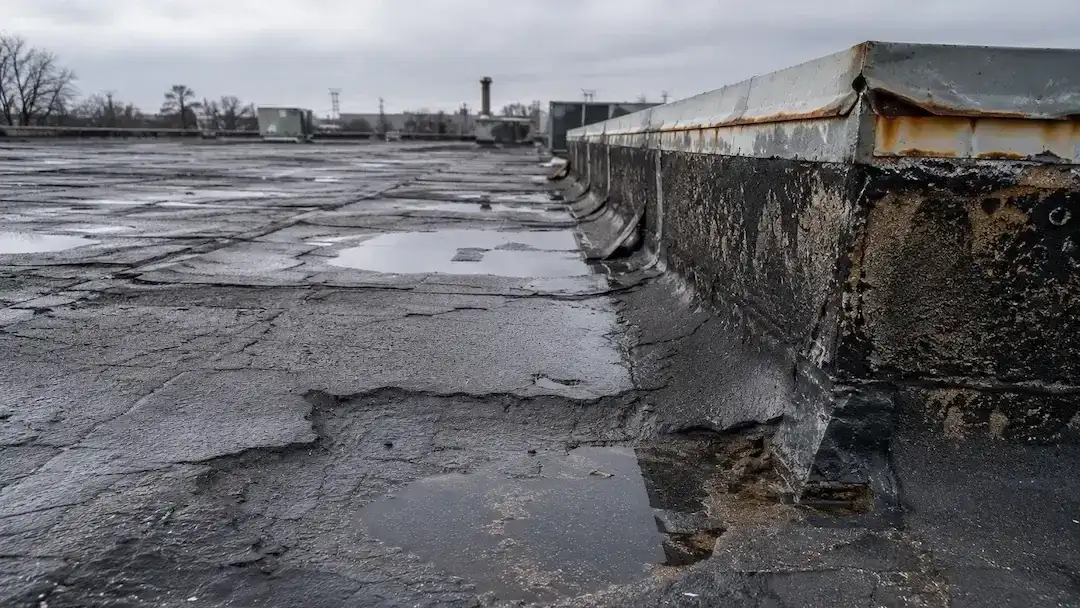
Ponding makes it worse. Flat roofs that have settled, or that were built with marginal slope, hold water after every storm. Standing water accelerates membrane breakdown and is one of the first things an underwriter's inspector notes. Add summer UV, rooftop foot traffic from HVAC servicing, and snow load, and the local reality is that a GTA commercial roof often hits its insurance thresholds a few years before its theoretical age would suggest. The fix isn't dramatic — consistent drainage and early repair of small failures buys real years — but it has to happen before the condition is baked in. Crown's commercial roofing crews work across Toronto and the GTA on exactly this kind of life-extension work.
Membrane type changes the underwriter's math
Not all flat roofs age the same way in an insurer's eyes, and knowing where yours sits helps you predict the conversation.
Two-ply SBS modified bitumen — still the workhorse on GTA commercial and industrial buildings — is generally viewed as durable, but underwriters know its failure modes (seam separation, granule loss, blistering) and will look for them once it's past 15. Single-ply TPO and EPDM are judged heavily on installation quality and seam integrity; a well-welded membrane ages gracefully, a poorly fastened one does not. Older built-up and tar-and-gravel systems are robust but, once they're 20-plus, are often the first flagged for an ACV switch simply because of their age class.
The takeaway isn't that one system is "better for insurance." It's that the insurer is going to assess your specific roof's condition against what's normal for its type — which means the evidence you can produce about that condition matters as much as the membrane itself.
The single document that keeps an aging roof insurable
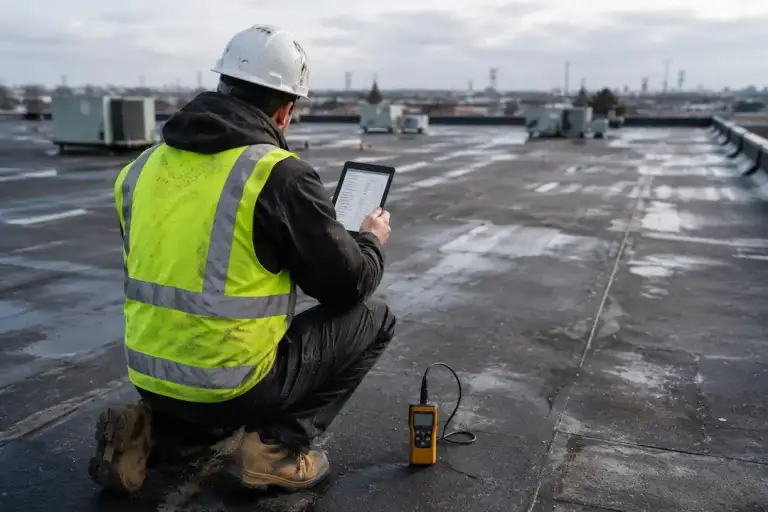
If there's one move that consistently changes renewal outcomes, it's having a current, professional roof condition report. Institutional landlords and a growing number of insurers now expect a written assessment with condition ratings, photo documentation, repair priorities, and an estimate of remaining service life. The difference it makes is straightforward: without it, the underwriter prices the uncertainty of an old roof and protects themselves with ACV or non-renewal. With it, they're pricing a known, maintained asset — and a roof with five documented good years left is a very different risk than an unknown 20-year-old.
A useful report is more than a walkaround. It pairs a visual assessment with non-destructive testing — an infrared moisture scan finds saturated insulation under an intact-looking surface, which is precisely the hidden problem that turns into a denied claim later. The other half of the value is cadence. Industry practice is two inspections a year, in spring and fall, plus a documented check after any major wind, hail, or ice event so the timeline is on record before a claim is ever filed. Booking spring and fall roof inspections is the cheapest insurance-adjacent thing a property manager can do, and it produces exactly the paper trail carriers now ask for.
What to do 12–24 months before your roof becomes a renewal problem
The owners who never get the bad letter tend to act while the roof is in its late teens, not after the non-renewal lands. A practical sequence:
Pull your actual roof age and membrane type from the building records — not the estimate in someone's memory. Get a professional condition report with remaining-life estimate and a prioritized repair list, then clear the small, cheap items (failed flashing, ponding, open seams) before they become the underwriter's evidence against you. Keep the report, the photos, and the repair invoices together as a maintenance file, because that file is your argument at renewal. Ask your broker, in writing, what roof age and condition thresholds your specific carrier applies — the answer tells you exactly how much runway you have. And if the report shows the roof is genuinely near end of life, start budgeting a planned roof replacement on your terms, in a good-weather window, rather than as an emergency after a coverage drop forces your hand.
Done early, every one of these steps is inexpensive. Done after the renewal letter, they're a scramble — and you're negotiating from the weakest possible position.
Frequently asked questions
Does insurance cover commercial roof replacement?
For sudden, accidental, insured events — wind, fire, falling objects — typically yes. For age, wear, or long-term leaks, generally no. Roof age and documented condition heavily influence whether a claim is paid at full replacement cost or only depreciated value.
At what age does a commercial roof start affecting insurance in Ontario?
Premium and coverage changes commonly begin around 15 years, with stricter conditions, mandatory inspections, or non-renewal more likely past 20. Condition and documentation can extend or shorten that window significantly.
What's the difference between replacement cost and actual cash value on a roof?
Replacement cost pays what a comparable roof costs to install today. Actual cash value pays the depreciated amount — replacement cost minus wear — which on an older roof can be a small fraction of the real cost.
Can an insurer refuse to renew a commercial policy because of the roof?
Yes. An aging roof in undocumented or poor condition is a common reason carriers add restrictive endorsements, switch to ACV, or decline to offer renewal terms.
Do commercial insurers in Ontario require a roof inspection report?
Many now expect a written condition report with repair priorities and estimated remaining life, especially for older roofs. A current report often changes how favourably the roof is underwritten.
How often should a commercial flat roof be inspected for insurance purposes?
Twice a year — spring and fall — plus after any significant wind, hail, or ice event, with photos and dates retained to support future claims.
Thinking about your next renewal? Crown Industrial Roofing has assessed and maintained commercial flat roofs across the GTA for nearly 50 years, and we produce insurer-ready condition reports that property managers can hand straight to their broker. Book an assessment before your roof becomes the reason for the next letter.
Crown Industrial Roofing
227 Queens Plate Dr, Unit #3, Etobicoke, ON M9W
6Z7 (416) 744-7788 ·
crownroofing.ca
Recent Posts
Book your free roofing inspection
Protect your building with confidence. Our team responds across Toronto and the GTA — and our emergency line runs 24/7.