
What Damages a Flat Roof the Most in Toronto's Climate? (And What Property Managers Can Do About It)
Freeze-thaw, ponding water, UV, wind uplift — 8 causes of flat roof damage in Toronto and what commercial property managers can do about them.
- Jun 7
This post is for property managers and building owners who are already dealing with something — a leak, a repair quote, an inspection report with items flagged red — and want to understand what actually caused it. Not for people still deciding whether to pay attention to their roof. That's a different conversation.
Flat roofs in Toronto don't fail randomly. They fail for specific, repeatable reasons — most of them observable at an early stage if you know what to look for and when. The problem is that most building owners only go looking after the ceiling tile starts dripping, which is the late stage of a failure chain that usually started six to eighteen months earlier.
What follows is the complete breakdown: eight primary damage causes, the way each one manifests on EPDM, TPO, and SBS modified bitumen, and a practical framework for catching the damage before it becomes catastrophic. Crown has been working on commercial and industrial flat roofs across Toronto and Etobicoke since 1977. These aren't theoretical failure modes. They're what we find on roofs every week.
The 8 Causes at a Glance — Before We Get Into the Detail
If you want the skeleton before the muscle, here it is. Toronto commercial flat roofs fail for eight primary reasons, roughly in order of how often we see them:
- Ponding water — the most damaging single force on a flat roof in this climate.
- Thermal cycling — Toronto's freeze-thaw season oscillates 30–40 times per winter. Every cycle stresses seams and flashings.
- UV degradation — summer sun breaks down unprotected membrane surfaces faster than most building owners expect.
- Foot traffic and HVAC service damage — unmanaged rooftop access is a slow, invisible damage accumulator.
- Snow load and ice damming at parapets — the leak that shows up at the interior parapet wall post-thaw is almost always this.
- Seam, flashing, and penetration failure — where the membrane has to transition is where it fails first.
- Wind uplift — perimeter and corner sections on exposed GTA rooftops, especially on aged TPO and EPDM.
- Biological growth — moss, lichen, and algae on north-facing sections hold moisture and degrade surfaces over time.
That's the skeleton. The rest of this post is the muscle — what each one actually looks like, why Toronto makes it worse, and how to catch it early.
Why Toronto's Climate Makes Flat Roof Damage Worse Than Most Markets
Most roofing research and manufacturer testing is calibrated to US markets — Phoenix, Houston, Atlanta. Toronto's climate profile is different enough that the conclusions don't always transfer cleanly. Two factors in particular separate the GTA from most North American comparisons.
Freeze-thaw frequency: 30–40 cycles per winter, not just extreme cold
It's not that Toronto gets record-setting cold. It's that temperatures oscillate above and below zero repeatedly throughout the winter — sometimes within the same 48-hour window. Each oscillation is a stress event: water expands when it freezes in seam gaps and penetration collars, then contracts when it thaws. Over twenty years, that's 600 to 800 stress cycles on the most vulnerable parts of your roof system. The cumulative effect is why Toronto roofs age differently than roofs in cities with drier, more stable winter climates.
Ontario Building Code also sets minimum thermal performance requirements (R-30 effective for most commercial re-roofs) that affect how membranes are attached and how the full assembly performs. A membrane spec that ignores the insulation underneath it is an incomplete spec.
Spring thaw volume and ponding — the drainage window that catches most roofs unprepared
Toronto's spring thaw concentrates large volumes of snowmelt over a short window, and if your drains, scuppers, and slope can't handle the flow rate, no membrane saves you. What's often missed: even partially blocked drains that perform adequately during summer rainfall events can fail completely under spring melt volume. Debris accumulates all winter under the snow pack, and then becomes a drain obstruction exactly when drainage is most critical.
This is why drainage is the single most important factor in flat roof longevity in this market — more than membrane type, more than installation method. A TPO roof with adequate drainage outperforms an SBS roof sitting under 2 inches of standing water every April.
#1 Ponding Water (And Why Toronto's Spring Thaw Makes It Worse)
What's actually happening to the membrane
Flat roofs aren't actually flat. They're designed with a slight slope — typically 1:50 under OBC — to move water toward drains. When those drains block, when insulation compresses unevenly over time, or when the deck deflects under load, water stops moving. It pools. It sits.
The industry threshold is 48 hours: water remaining on a roof membrane more than 48 hours after a rain event is classified as ponding, and virtually every major membrane manufacturer lists it as a warranty exclusion. Sustained hydrostatic pressure softens membrane adhesives, works under lap edges and seam joints, and degrades the insulation below — which then accelerates structural deck deterioration. We've seen ponding water take 5 to 8 years off an otherwise healthy membrane.
Why it's worse in Toronto
Spring thaw creates a drainage demand spike unlike anything summer rainfall produces. Snowmelt volume is high, the flow rate is sustained over days, and debris that accumulated under the snow pack reaches the drain grates all at once. Drains that clear normally during August rainstorms are overwhelmed in April. The ponding that results isn't just a nuisance — it's sitting on a membrane that's already been through 35 freeze-thaw cycles and is at its most fatigued state of the year.
What it looks like on inspection
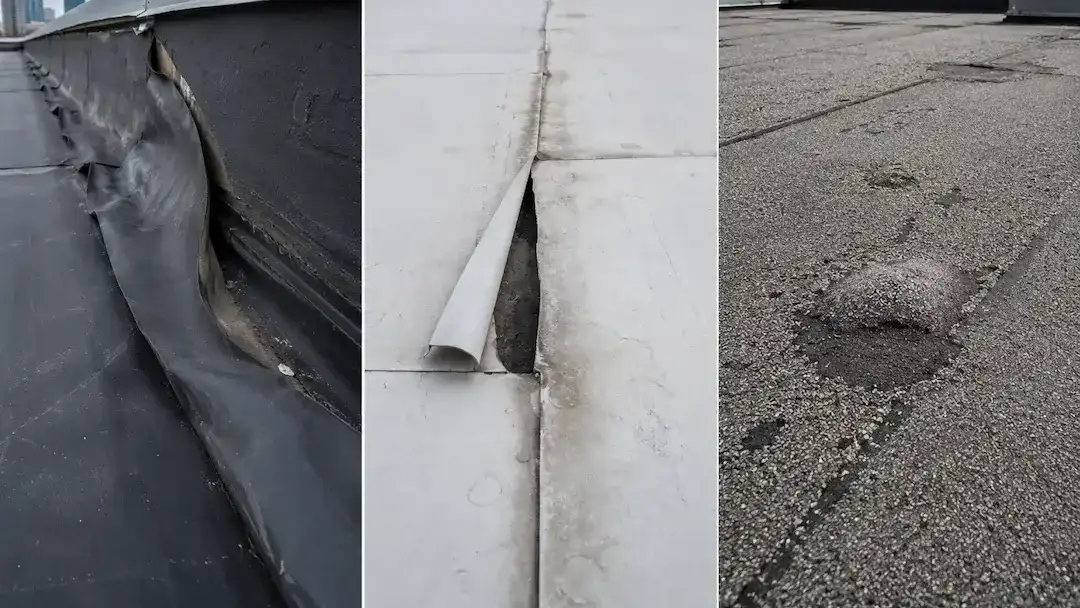
Tide marks or staining rings on the membrane surface; algae or biological growth concentrated in low spots; soft or spongy areas underfoot when walking the roof; drain grates partially obscured by compacted debris. Any of these warrant immediate attention — not a note on next quarter's agenda.
#2 Thermal Cycling — Toronto's Freeze-Thaw Killer
What's actually happening to the membrane
Every material expands when it heats and contracts when it cools. The problem is that different components of a roofing assembly expand and contract at different rates — the membrane, the insulation board, the metal flashing, the structural deck. Over hundreds of thermal cycles, that differential movement creates stress at every transition point in the system: seams, flashing corners, penetration collars, parapet terminations.
Why it's worse in Toronto
Toronto's winter isn't just cold — it oscillates. Temperatures routinely cross above and below zero multiple times per week from November through March. A roof in Edmonton might go below zero and stay there for weeks; a Toronto roof goes below zero, comes back up, drops again. Each crossing is a stress event. Over 20 years of GTA winters, the cumulative stress on seams and flashings is substantially higher than in most Canadian cities with more stable cold seasons.
The failure pattern is predictable and slow: seams open slightly, flashings lift at corners, sealants crack at penetration boots. None of these are dramatic in the early stage. They're hairline separations. But they're entry points. Water gets in at a hairline gap, freezes, widens the gap further on the next cycle. By spring, a 2mm separation in November is a 15mm opening.
What it looks like on inspection
Lifted flashing corners at parapet walls; visible separation at seam laps that hadn't been there the previous autumn; cracked or missing sealant at pipe penetrations and HVAC curb edges. These are early-stage findings — the right response is a repair, not a replacement.
#3 UV Degradation
What's actually happening to the membrane
UV radiation breaks down the organic polymers in roofing membranes over time. All membranes contain them. The rate of degradation depends on membrane type, surface treatment, and accumulated UV exposure — and it accelerates significantly once the surface protection layer is compromised. A UV-damaged membrane is also more vulnerable to every other damage type on this list: it absorbs more heat, becomes more brittle in cold, and loses the elasticity that allows it to accommodate thermal movement.
Why it's worse in certain roof zones
South-facing and west-facing sections receive the most cumulative UV load on a Toronto rooftop. Dark membranes — uncoated EPDM and SBS modified bitumen — absorb more heat and oxidize faster. Reflective membranes like white TPO perform better, but the coating itself degrades over time, typically showing chalking or micro-cracking at the 10 to 15-year mark on standard 60-mil product.
What it looks like on inspection
Surface bleaching or colour shift; "alligatoring" (a cracked, scaly texture on the membrane surface); brittleness and crumbling at edges and terminations; granule loss and exposed bitumen on SBS cap sheets. Once alligatoring is visible, the membrane's useful life is measured in years, not decades. A post-summer inspection in September or October is the right time to catch and document UV progression before the next winter season.
#4 Foot Traffic and HVAC Service Damage
What's actually happening
Commercial flat roofs are working surfaces. HVAC technicians, telecommunications contractors, fire inspection crews, solar maintenance staff, and others access the roof regularly — often without coordinating with building management and without any record being kept. Every unplanned visit is a potential damage event. Concentrated point loads from equipment, tool drops, knee pressure on membranes that weren't rated for it, dragged equipment carts crossing raised seam laps — these are routine occurrences on GTA commercial rooftops and they accumulate quietly.
Why industrial buildings in Etobicoke are particularly exposed
Large industrial facilities with significant rooftop mechanical footprints — multiple RTUs, exhaust stacks, satellite equipment, solar arrays — have high access frequency and correspondingly high damage risk. The membrane zone immediately around HVAC curbs is almost always the most worn section of the roof: repeated access, chemical exposure from condensate lines, vibration transfer from running equipment, and the concentrated foot traffic of technicians working in a small area over many years.
What it looks like on inspection
Scuffs, scrapes, and concentrated wear patterns near mechanical equipment; punctures or small tears in the membrane field near curbs and penetrations; displaced or missing walkway pads. The management fix is simple and rarely implemented: designated walkway pads between the roof hatch and all mechanical equipment, plus a roof access log that records who was up there and when. If a damage pattern appears after a third-party contractor visit, you need that record.
#5 Snow Load and Ice Damming at Parapets
What's actually happening
Toronto's OBC snow load requirements are designed to handle structural load under normal accumulation conditions. The more common operational problem isn't structural failure — it's what happens during partial melt cycles. Snow melts from the bottom up (heat loss through the roof deck) and from the top when temperatures rise above zero. That meltwater has to go somewhere. If drains are blocked by ice or debris, it pools invisibly under the snow pack and exerts sustained hydrostatic pressure on the membrane.
Ice damming at parapets: the failure mode most property managers miss
At parapets, the melt-refreeze dynamic creates ice dams. Meltwater runs toward the parapet, refreezes when temperatures drop at night, and builds up over weeks. The backed-up water is then forced under the membrane termination — the exact point where the membrane meets the vertical face of the parapet wall. The leak from this failure mode shows up at the interior parapet wall, not at a drain or field penetration. Building managers often assume it's a wall issue or a window issue and call the wrong contractor first.
What it looks like on inspection
Post-thaw: staining or efflorescence on interior parapet walls; ice residue at parapet corners in early spring; membrane termination that has pulled away from the parapet face. A fall inspection before freeze-up — clearing debris from drains and scuppers and confirming flashing integrity at all parapet terminations — is the most direct preventive action available.
#6 Seam, Flashing, and Penetration Failure
Where flat roofs fail most often — and why it's not the field membrane
If you had to pick the single location where flat roofs fail most often, it's not the open field of the membrane. It's everywhere the membrane has to transition: seams where two sheets overlap, flashings where the membrane meets a vertical surface, and penetration collars around pipes, vents, drain bowls, and HVAC curbs. These are the stress concentration points — where differential movement accumulates, where water is most likely to find a path, and where installation quality matters most.
A perfectly installed field membrane can be completely undermined by a single improperly sealed penetration boot. The boot fails, water infiltrates, travels along the insulation plane, and surfaces as a leak at a different location entirely. The misdiagnosis — patching where the water appears rather than where it entered — is one of the most common reasons roofs keep leaking after a repair.
What it looks like on inspection
Visible separation at seam lap edges; flashing corners that have lifted or pulled away from the wall; missing or cracked sealant at pipe penetrations; drain collars that have separated from the membrane field. On Toronto buildings, the north-facing parapet wall is the most commonly missed location — reduced UV exposure means the deterioration is slower, but the thermal cycling exposure is actually higher than south-facing sections, making it more vulnerable over the long term.
#7 Wind Uplift
What's actually happening
Wind creates positive pressure on windward building faces and negative pressure — suction — on the roof surface. At the perimeter and corners, where OBC wind load calculations show the highest uplift forces, that suction tries to peel the membrane away from its substrate. On mechanically fastened systems, it strains the fastener pattern at the edges. On adhered systems, it stresses the bond between the membrane and insulation board.
Where GTA rooftops are most exposed
Toronto doesn't carry hurricane risk, but exposed industrial sites in Etobicoke and along the Lakeshore corridor see significant wind events — particularly in fall and spring. Aged TPO and EPDM roofs with degraded adhesive at the perimeter are the most vulnerable. The first visual sign is a slight raised section or bubbling at the roof edge — easy to dismiss as cosmetic, genuinely dangerous as a progression point if it goes through another winter without being re-secured.
#8 Biological Growth (Moss, Lichen, Algae)
Why biological growth is a structural problem, not just an aesthetic one
Moss and lichen hold moisture against the membrane surface continuously — creating a sustained wet contact that's more damaging than ordinary ponding because it's localized, persistent, and largely invisible from street level. Lichen produces organic acids that degrade bituminous surfaces over time. Algae growth in low spots signals chronically wet conditions that need drainage correction, not just cleaning.
North-facing roof sections and areas in the shadow of mechanical equipment are the primary growth locations on Toronto commercial buildings — reduced UV exposure slows moisture evaporation and allows biological communities to establish over multiple seasons. Because these areas also tend to have lower foot traffic, the growth can persist for years before anyone on the ground notices.
What it looks like on inspection
Green, black, or grey biological growth on membrane surfaces, particularly on north-facing sections; staining patterns radiating outward from low spots; surface texture change on SBS granule cap sheets where lichen is attaching to the granule surface. Remediation involves both mechanical removal and drainage correction — cleaning alone without fixing the moisture condition that allowed the growth produces temporary results.
Membrane-Specific Failures — EPDM, TPO, and SBS Modified Bitumen
The eight damage causes above apply across all flat roof systems. But each membrane has its own failure signature — the specific way it tends to go wrong, driven by its material properties and installation method. The three membranes most common on Toronto commercial buildings each tell a different story.
EPDM — where it fails first
EPDM (ethylene propylene diene monomer) is the synthetic rubber membrane that went onto a significant portion of Toronto's industrial and warehouse stock from the 1980s through the early 2000s. There's a lot of it in this city, and much of it is at or approaching the end of its rated lifespan.
EPDM's primary failure mode is shrinkage. The rubber membrane contracts over time — particularly in climates with significant thermal cycling — and pulls away from its termination points. Flashing separations at parapet walls, pipe penetrations, and drain edges are the consequence. This isn't always visible from a distance; you have to be on the roof looking at the termination details up close to catch it at the early stage.
The seam system is the second vulnerability. EPDM seams are bonded with contact adhesive and seam tape — not heat-welded like TPO or PVC. Adhesive bonds degrade with age and UV exposure, and they're vulnerable to the same freeze-thaw cycling that stresses the membrane itself. EPDM seams on roofs more than 15 years old deserve specific, careful attention during any inspection. For emergency winter replacements, EPDM's cold-installation tolerance is a genuine advantage — it's one of the few membrane types that can be installed reliably below zero when properly detailed.
TPO — weak points
TPO is the dominant membrane on newer Toronto commercial buildings, and its heat-welded seam system is a genuine structural advantage over adhesive-bonded alternatives. A properly welded TPO seam is often stronger than the field membrane itself. That strength is also where complacency enters the picture.
TPO's primary failure points are flashing details, not field seams. The corners, inside angles, and penetration wraps require careful hand-welding technique that doesn't always match the quality of machine-welded field seams. Those complex geometry details are where we find failures — not the long straight runs, but the irregular transitions that demand more from the installer's skill level.
Product quality variation also remains a real issue in the TPO market. The industry had significant compound consistency problems in the 2000s, and while major manufacturers have improved, not all TPO is equivalent. A 60-mil roll from a top-tier manufacturer outperforms a 90-mil roll from a low-cost supplier in cold-weather flexibility and UV stability. Ask your contractor for the specific manufacturer and product line, not just "TPO."
SBS modified bitumen — seams, punctures, blistering
SBS modified bitumen has a proven track record on Toronto industrial facilities and commercial plazas. It's a resilient system — but it ages in layers, and what looks like surface wear can mask subsurface failure that a visual-only inspection misses.
The three common failure patterns: seam failure, where multi-layer laps separate over time due to thermal cycling or inconsistent torch application during original installation; punctures from foot traffic and impact (SBS is more resistant than EPDM but not impervious, especially as the granule surface ages and the bitumen hardens); and blistering, which is the most frequently misread finding.
Blisters in modified bitumen form when moisture trapped below the membrane — from wet substrate at installation or from water infiltration that worked under the field membrane — vaporises under summer heat and pushes up from below. A blister that's dry inside when cut open is inert: the moisture escaped and the blister is stable. A blister with moisture inside indicates active infiltration and demands immediate investigation. Most property managers can't tell the difference without opening it — which is exactly the right moment to call for an expert roof inspection rather than guessing.
Side-by-Side: How Each Membrane Handles Toronto's Damage Causes
Vulnerability by damage type across EPDM, TPO, and SBS modified bitumen
Damage Cause
EPDM
TPO
SBS Modified Bitumen
Ponding Water
Moderate — seams vulnerable to sustained hydrostatic pressure
Moderate — welded seams hold better, but field membrane degrades
Low-moderate — 2-ply provides backup if cap sheet breaches
Thermal Cycling
High — shrinkage causes flashing and termination separation
Low-moderate — heat-welded seams resist cycling well
Moderate — seams torch-fused; can separate if installation was inconsistent
UV Degradation
High — black membrane absorbs heat; surface oxidises over time
Low — white membrane reflects 70–80% solar radiation
High — dark granule surface absorbs heat; granule loss exposes bitumen
Foot Traffic / HVAC
High — puncture-prone; HVAC curb zones wear quickly
Moderate — depends on mil thickness; 80-mil handles traffic better
Low — 2-ply redundancy provides real-world durability advantage
Snow Load / Ice Damming
Moderate — parapet termination the primary vulnerability
Moderate — same parapet and corner risk as EPDM
Low-moderate — heavier system; parapet detailing same concern
Seam / Flashing Failure
High — adhesive seams and shrinkage-prone terminations
Low for seams (heat-welded); moderate at complex flashing geometry
Moderate — torch quality at seams variable; flashings consistent if done right
Wind Uplift
Moderate-high — aged adhesive at perimeter loses bond strength
Low-moderate — mechanically fastened edge is more resistant
Low — weight and multi-ply construction resist uplift well
Biological Growth
Moderate — black surface promotes growth in shaded zones
Low — white membrane dries faster; less hospitable to growth
Moderate — granule surface can provide attachment points for lichen
No system is immune to any of these causes. The table shows relative vulnerability — which is exactly why membrane selection should match your specific building's dominant risk profile.
How a Toronto Property Manager Can Catch Damage Before It's Catastrophic
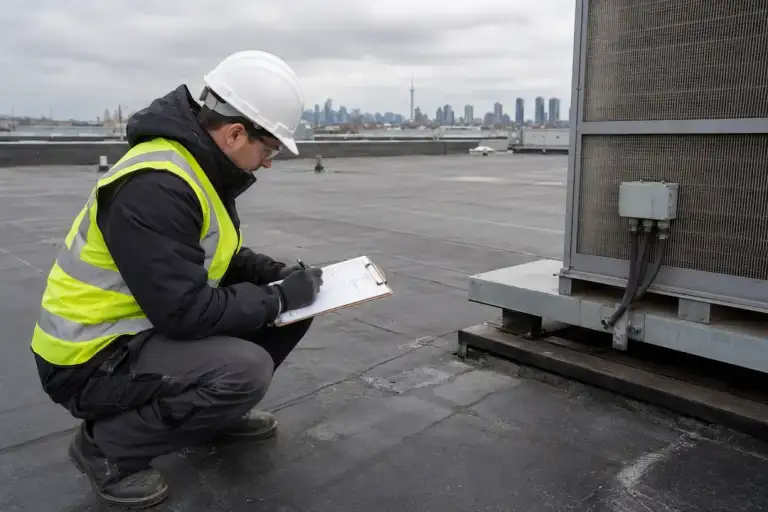
The damage causes above are serious and real. They're also observable at the early stage if you're looking in the right places at the right times. Most of the expensive repair situations we encounter started as a small, findable problem that sat for one season too long.
Build a twice-annual inspection rhythm. The two critical windows are post-winter (April/May) and pre-winter (October). Post-winter tells you what the freeze-thaw season did. Pre-winter gives you the chance to address it before the next one starts. Missing either window is how a hairline seam separation becomes a saturated insulation replacement. Crown's flat roof maintenance program structures exactly this — scheduled inspections with written condition reports and documented findings over time, not a phone call memory from three years ago.
Know what membrane system is on your building. This sounds obvious. It isn't — a significant number of property managers we meet don't know what's on their roof. Without that knowledge, you can't assess failure risk by type, can't have an informed conversation about repair scope, and can't evaluate whether a repair quote is using compatible materials. The original building permit drawings, the previous property manager's files, or a qualified roofer on-site for 20 minutes will answer the question. Find out before you need to make a decision under pressure.
Watch for interior indicators, not just the roof surface. Water staining on ceiling tiles, unexplained moisture on walls near parapets, and corrosion on structural steel near the roof deck are all indicators of membrane failure that has progressed past the early stage. By the time these appear, the leak has usually been running for weeks or months. They're still actionable — but they're late signals, not early ones.
Log every roof access. Every time someone goes on your roof — HVAC contractor, telecom crew, fire inspection, solar maintenance — log it. Date, company, purpose. If a damage pattern appears after a third-party contractor visit, you need that record. You also need to know when the last competent inspection was done so you can assess your current time-based risk accurately.
Act on inspection findings before the season changes. The most common version of a manageable problem becoming catastrophic: an inspection was done, issues were flagged, and nothing happened because budget approval was delayed or the follow-up fell between departments. The inspection is only as valuable as the action it produces. Crown's flat roof repair team targets same-week response on flagged items — because delay is where the cost multiplies.
If your building hasn't had a proper inspection in more than a year, the commercial flat roof lifespan guide is a useful companion — it walks through how long each membrane type should last under Toronto conditions, and where in the lifecycle your repair-versus-replace decision sits.
What Toronto Roofing Contractors Won't Tell You About Flat Roof Damage
A few things that consistently get glossed over.
Where the water appears is almost never where the leak actually is. Water travels. It follows the path of least resistance across the deck — through the insulation, along structural members — before it finds an exit point into the building. A patch at the drip location fixes the symptom, not the source. This is the single most common reason flat roofs keep leaking after a repair. Proper diagnosis traces the water back to its entry point, which requires getting on the roof with a thorough inspection protocol, not just looking at where the ceiling tile is wet.
Manufacturer warranties and workmanship warranties are not the same thing. A 20-year manufacturer warranty covers material defects. It does not cover installation errors. If a crew installs a blister over a wet insulation board and it fails in year four, that's a workmanship issue — the manufacturer won't cover it, and neither will a contractor whose warranty expired in year two. Ask for both warranties in writing and understand what each covers before you sign anything.
Most flat roof failures aren't caused by age — they're caused by lack of maintenance. Industry data consistently points to 80–90% of premature roof failures tracing back to insufficient maintenance rather than material defects or age alone. A well-maintained 18-year-old EPDM roof outperforms a neglected 10-year-old TPO. The membrane matters less than what happens to it over its lifetime.
The inspection report is only as useful as the follow-through. We've walked buildings where inspection reports from two or three prior contractors were on file — flagging the same issues each time — with no record of repairs being completed. The documentation creates a false sense of management. An inspection that doesn't result in repairs on flagged items is a paper exercise. The value is in the action, not the report.
FAQ
What damages the roof the most?
Ponding water is the single biggest threat to commercial flat roofs in Toronto. Water sitting on a membrane for more than 48 hours after rain actively degrades the membrane surface, softens the insulation below, and accelerates seam and flashing failure. Combined with Toronto's freeze-thaw cycle — which can repeat 30 to 40 times in a single winter — ponding water creates the conditions that cut years off a flat roof's rated lifespan faster than any other single cause.
What are three common problems you'll find on modified bitumen roofs?
The three most common problems on modified bitumen (SBS) roofs are: (1) seam failure, where the overlapping layers separate over time due to thermal cycling or inconsistent torch application during original installation; (2) punctures and surface cracks from foot traffic, HVAC service activity, or debris impact — modified bitumen is more puncture-resistant than EPDM but not immune, particularly as the granule surface ages and the bitumen hardens; and (3) blistering, which occurs when moisture trapped below the membrane turns to vapour under summer heat and pushes up from below. A dry blister is inert. A wet blister indicates active moisture intrusion and demands immediate investigation — not a wait-and-see approach.
What are the disadvantages of EPDM roofing?
EPDM's main disadvantages on Toronto commercial buildings are: shrinkage over time as the rubber membrane ages and contracts, pulling flashings away from parapet walls, penetrations, and drain edges; susceptibility to puncture from foot traffic and rooftop equipment contact; adhesive-bonded seams that are more vulnerable than heat-welded seams to age and freeze-thaw cycling; and limited resistance to petroleum-based substances, which is a concern on industrial roofs with HVAC condensate exposure. In the GTA, shrinkage is the dominant failure mode on EPDM roofs more than 15 years old.
What are the disadvantages of modified bitumen roofing?
Modified bitumen's key disadvantages are: the dark surface colour absorbs significantly more heat than white TPO, increasing cooling loads in summer and accelerating UV oxidation; torch-applied installation carries open-flame fire risk that must be managed with proper fire watch protocols and certified crews; the material becomes more brittle in extreme cold, increasing vulnerability to impact cracking during Toronto winters; blistering from subsurface moisture is a persistent issue, particularly on older installations over aging deck substrates; and the system is heavier than single-ply options, which matters on buildings with structural deck limitations.
Not sure which damage type you're dealing with, or whether what you're seeing warrants a repair call or just monitoring? Crown has been inspecting and repairing commercial flat roofs across Toronto and Etobicoke since 1977. We'll get someone on your roof, tell you exactly what we find, and give you a straight answer on what it needs — before you've committed to anything.
Book a same-week inspection →
Damage assessments and failure descriptions in this article reflect Crown Industrial Roofing's project experience across Toronto and GTA commercial buildings. Every roof is different. Always request a written, itemized inspection report from a licensed roofing contractor before making a repair or replacement decision.
Recent Posts
Book your free roofing inspection
Protect your building with confidence. Our team responds across Toronto and the GTA — and our emergency line runs 24/7.