
Why Toronto Commercial Flat Roofs Fail Years Early — Membrane-by-Membrane Lifespan Deep Dive
How long does a commercial flat roof actually last in Toronto? Real TPO, EPDM, and modified bitumen lifespans by membrane — not manufacturer hype.
- May 31
If you manage a commercial or industrial building in Toronto, you've probably been told your roof should last 20, 25, maybe 30 years. That number came from a manufacturer spec sheet — tested somewhere with a more forgiving climate than ours.
This is the companion piece to how often flat roofs need to be replaced in Canada, which covers the broad strokes: 10–30 years, depending on material and maintenance. That range is accurate, but it's wide enough to be almost useless if you're staring at a 16-year-old TPO roof trying to figure out whether you've got five years left or five months. This post narrows it down — membrane by membrane, with Toronto's climate factored in, not the manufacturer's lab conditions.
We'll walk through what each major system actually delivers here, what cuts that number short, and what adds years back. If your roof is somewhere in that 12–25 year window, this is the post that tells you where you actually stand.
The Gap Between Manufacturer Lifespan and Toronto Reality
Every membrane manufacturer publishes a lifespan figure. Those numbers aren't fabricated — they come from accelerated weathering tests and warranty actuarial data. But they're also generalized across climates that don't put a roof through what Toronto does.
In one calendar year, a Toronto commercial roof goes through dozens of freeze-thaw cycles, several major snow loads, summer UV exposure intense enough to bake asphalt, and — depending on the building — near-constant HVAC technician foot traffic. Manufacturer warranty testing rarely simulates all of that stacked together, year after year, for two decades straight.
The result: a membrane rated for 25 years in a moderate climate often delivers something closer to 18–22 years on a Toronto rooftop with average maintenance. With poor maintenance, that number drops further. With excellent maintenance — and we mean documented, twice-yearly inspections, not "someone looked at it once" — a building owner can sometimes beat the manufacturer number, not just meet it.
The honest version of this conversation isn't "your roof will last X years." It's "here's the realistic range for your membrane in this climate, and here's what determines where in that range you land."
TPO in Toronto — Why 25-Year Promises Often Deliver 18-22 Years
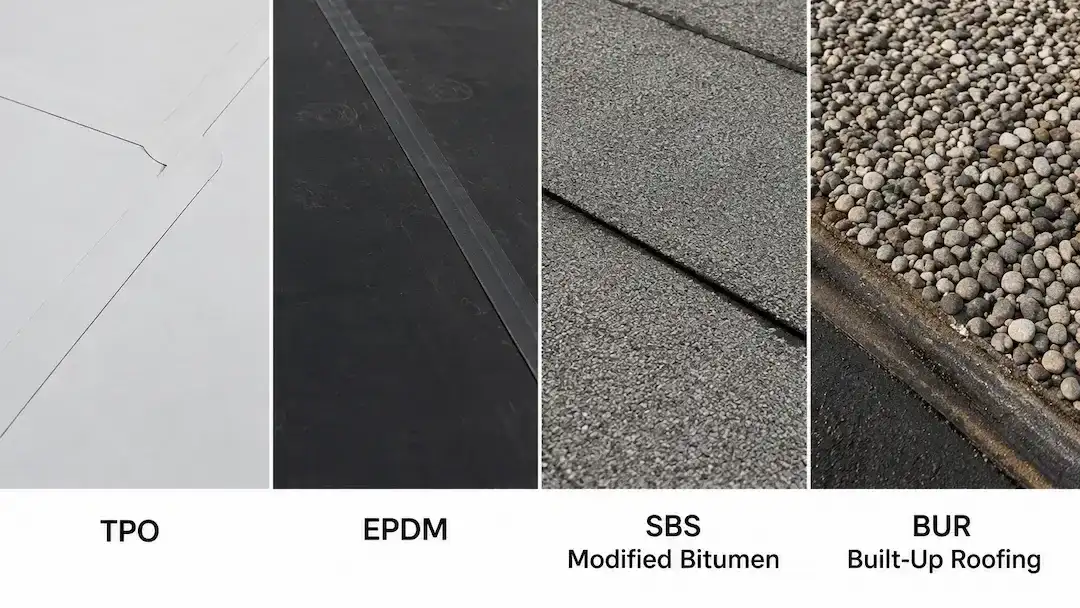
TPO (thermoplastic polyolefin) is one of the most common single-ply systems on Toronto commercial roofs right now, largely because it's cost-effective to install and performs well against grease and chemical exposure.
Manufacturer literature typically claims 20–25 years. In Toronto, realistic lifespan runs 15–20 years, and the gap comes down to two structural facts about how TPO is made and installed.
First, TPO is a thin, single-ply membrane. It doesn't have the layered redundancy of a built-up or modified bitumen system — if the membrane is compromised, there's no second layer underneath catching the problem. Second, and more importantly for Toronto specifically: TPO's seams are heat-welded, and weld quality depends entirely on installer skill and weather conditions during installation. A properly heat-welded TPO seam can be stronger than the membrane itself. A poorly welded seam — done too fast, in the wrong temperature, by a crew without proper QC — becomes the first failure point, often well before the field membrane itself shows any wear.
We see this constantly: a TPO roof with a clean, undamaged field membrane that's failing at the seams and flashings because the original install rushed the welds. That's not a 20-year roof. That's a 12-year roof with a 20-year membrane on it.
If your TPO roof is in the 12–18 year range and you haven't had seam-specific inspection (not just a general walk), that's the first thing to check before assuming you're closer to replacement than you actually are.
EPDM in Toronto — The Most Forgiving Membrane (and Its One Soft Spot)
EPDM (ethylene propylene diene monomer) is synthetic rubber, and it's been on Toronto commercial roofs longer than almost anything else on this list. It has a reputation as the most forgiving system in a freeze-thaw climate, and that reputation is earned.
Manufacturer claims often reach 25–30 years. Realistic Toronto lifespan: 20–25 years. That's a smaller manufacturer-to-reality gap than TPO, and the reason is straightforward: EPDM's rubber composition gives it genuine flexibility through temperature swings. It expands and contracts with freeze-thaw cycling without the brittleness that shortens other membranes' lives.
The soft spot is the seams and terminations — not the field membrane. Older EPDM installations used seam tape and adhesives that, after 15-20 years of UV and weather cycling, can become brittle and start pulling away from parapet walls, curbs, and penetrations. The field of the membrane is often still structurally sound when the terminations start to fail. That's a maintenance and resealing issue, not a full-replacement issue — but only if it's caught before water gets behind the membrane and starts working on the insulation underneath.
EPDM also doesn't handle grease exposure well, which is irrelevant for most commercial buildings but worth flagging if your building has restaurant tenants venting onto the roof — that's a faster degradation path than freeze-thaw alone.
SBS Modified Bitumen in Toronto — Real Lifespan and Why 2-Ply Outlasts 1-Ply
Modified bitumen is the system most likely to be confused with EPDM by building owners, since both get casually called "rubber roofs." They're not the same thing — modified bitumen is asphalt modified with rubber or plastic polymers (SBS for a rubberized quality, APP for a more plasticized one), reinforced with fabric, and installed in overlapping layers.
This is where ply count matters more than almost anything else on this list. 2-ply SBS modified bitumen systems realistically deliver 20–25 years in Toronto. 1-ply systems land closer to 15–18 years.
The logic is simple: a 2-ply system has built-in redundancy. If the cap sheet develops a localized weakness, the base ply is still there doing its job. A 1-ply system doesn't have that backup — once the single layer is compromised in a given spot, that's the whole system's defense in that location. In a city with this many freeze-thaw cycles per winter, that redundancy isn't a luxury upgrade. It's the difference between a roof that ages predictably and one that fails in patches.
Modified bitumen's other Toronto-specific advantage is how it handles foot traffic and rooftop equipment loading — it's more puncture-resistant than thin single-ply membranes, which matters if your roof sees regular HVAC servicing. The tradeoff is installation complexity: torch-applied modified bitumen requires skilled crews and carries fire-safety considerations that self-adhering or cold-applied versions avoid.
BUR (Tar & Gravel) in Toronto — Why the Old Workhorse Is Aging Out
Built-up roofing — multiple plies of asphalt-saturated felt or fiberglass, finished with a gravel or mineral cap — is the oldest system on this list, and it's still on a meaningful share of older Toronto commercial buildings.
Realistic Toronto lifespan: 18–22 years, though well-installed and well-maintained BUR systems can stretch beyond that. BUR has a genuine structural advantage: hot asphalt has a self-healing quality. Small fractures that develop during a harsh winter can partially reseal when summer heat softens the asphalt again. That's not true of any single-ply membrane on this list.
What ages BUR out isn't usually the field membrane failing outright — it's that BUR systems are heavy, labor-intensive to repair, and increasingly difficult to source skilled crews for, since fewer roofing contractors maintain the expertise to work with hot asphalt systems properly. We still install and repair BUR because it performs, but building owners with aging BUR roofs are often choosing replacement with a different system not because the BUR failed, but because finding contractors who can service it properly is getting harder every year.
If you have an older BUR roof that's still structurally sound, that's worth knowing before anyone tells you it needs to come off — but it's also worth planning the eventual transition rather than waiting for a forced emergency decision.
9 Toronto-Specific Things That Cut Every Membrane's Life in Half
Every membrane above has a realistic Toronto lifespan range. Where a specific roof lands within that range — or whether it falls short of it entirely — comes down to a small number of repeating factors we see across almost every premature failure we're called out for.
Skipped or DIY repairs
A patch job using the wrong material, applied by maintenance staff instead of a licensed roofer, often does more harm than the original leak. Incompatible materials can react with the membrane chemically, and a poor seal traps moisture rather than keeping it out.
Ponding water from poor drainage
Standing water that doesn't clear within 48 hours after rain is doing damage the whole time it sits there — UV breakdown accelerates, membrane degrades faster, and in winter, that ponding becomes ice load the structure wasn't necessarily designed for. Drainage and slope issues are one of the most common root causes behind "early" roof failure across every membrane type.
HVAC tech foot traffic without walk pads
Every service call to a rooftop unit is foot traffic on a membrane that wasn't designed to be walked on directly. Dropped tools, dragged equipment, and repeated foot pressure in concentrated paths wear through membranes years before the rest of the roof shows comparable wear. Walk pads around every serviced unit are inexpensive insurance against a problem that's entirely preventable.
Refrigerant and condensate leaks at units
HVAC condensate lines and refrigerant leaks deposit chemicals directly onto the membrane below the unit. Some of those chemicals are membrane-incompatible and cause localized breakdown that looks like unexplained deterioration if nobody connects it back to the equipment above.
Missed spring and fall inspections
Twice-yearly inspection is the industry standard for a reason. Small issues — a lifting seam, a cracked pipe boot, early ponding — are inexpensive to fix when caught early and expensive once they've had a season or two to work on the insulation and deck underneath. Most major repair jobs we see started as something minor that sat unaddressed.
Snow piled against parapets every winter
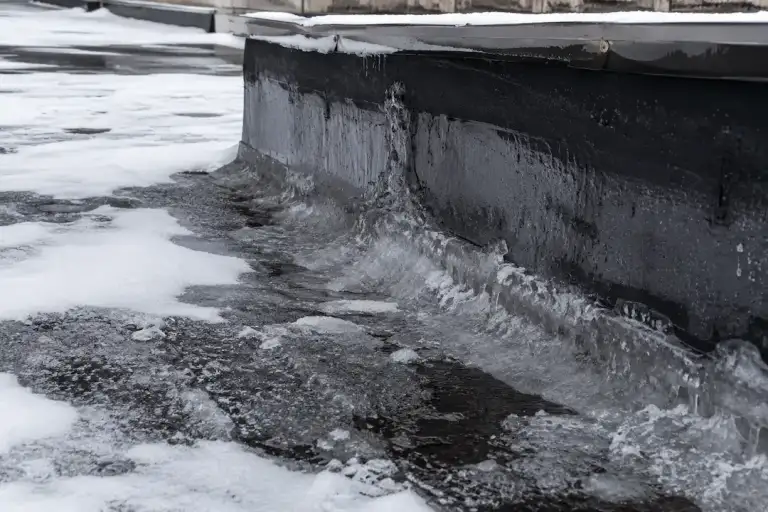
Snow removal crews need somewhere to put what they clear, and parapet walls are the convenient option. Repeated snow piling against parapets means repeated freeze-thaw concentration in one spot, plus meltwater that has nowhere to go but back onto the membrane or into wall assemblies it wasn't designed to handle.
Wrong membrane spec'd for the building type
A membrane chosen for upfront cost rather than building use case creates problems that show up years later. EPDM on a building with rooftop restaurant venting. TPO with inadequate puncture resistance on a roof with heavy equipment traffic. The wrong spec doesn't fail immediately — it just shortens the realistic lifespan range before anyone notices why.
Inadequate insulation R-value driving thermal stress
Insulation that doesn't meet current R-value standards forces the membrane to absorb more thermal cycling than it was designed for, since the building's heat loss and gain happen more directly through the roof assembly. This is also where building owners take a double hit: lower R-value drives up HVAC costs while simultaneously shortening membrane life.
Cut corners on the original install
Every membrane on this list performs close to its realistic range when installed correctly. None of them do when seams are rushed, fasteners are under-spec'd, or flashings are improperly detailed. A lot of "premature failure" stories trace back to install quality from a decade or more earlier — which is frustrating for a current building owner who may have inherited the problem along with the property.
How to Add 5-10 Years to Your Commercial Roof in the GTA
None of the factors above are exotic. They're avoidable with a maintenance approach that treats the roof as the capital asset it is, rather than something nobody thinks about until it leaks.
The building owners who consistently beat their membrane's realistic lifespan range share a few habits: documented spring and fall inspections (not informal walk-throughs — actual written assessments), prompt repair of small issues instead of deferred maintenance, walk pads at every piece of rooftop equipment, drainage kept clear year-round, and licensed repair work instead of in-house patch jobs.
That combination is most of what separates a TPO roof that makes it to 20 years from one that's struggling at 13. For more detail on what a proper maintenance program actually includes, see our commercial flat roof maintenance strategy guide.
How This Maps to "How Often Should You Replace?"
Our Canada-wide replacement timeline post covers the broader question of when replacement makes financial sense versus continued repair. This post is the membrane-specific detail that feeds into that decision: knowing your system's realistic Toronto lifespan range, and where your roof's age and condition sit within it, is what turns "how often do flat roofs get replaced" into a specific answer for your specific building.
If you're trying to figure out which system might replace your current roof, our upcoming comparison of TPO, EPDM, and modified bitumen for Toronto commercial buildings goes deeper into the installation and cost tradeoffs between systems.
FAQ
How long will a commercial roof last? Most commercial flat roofs last 15–25 years in Toronto's climate, depending on the membrane system and how well it's been maintained. EPDM and well-installed 2-ply modified bitumen tend toward the higher end of that range; single-ply systems like TPO and 1-ply modified bitumen tend toward the lower end.
What is the lifespan of a modified bitumen roof? A 2-ply SBS modified bitumen system realistically lasts 20–25 years in Toronto. A 1-ply system typically lasts 15–18 years. The difference comes down to the redundancy a second ply provides against localized membrane failure.
What is the life expectancy of an asphalt flat roof? Built-up roofing (BUR) — the traditional asphalt and gravel system — realistically lasts 18–22 years in Toronto, with well-maintained systems sometimes exceeding that. Hot asphalt's self-healing quality during summer heat is a genuine durability advantage over single-ply membranes.
How long does TPO roofing last? TPO is rated by manufacturers for 20–25 years, but realistic Toronto lifespan is closer to 15–20 years. Seam weld quality at installation is the single biggest factor separating TPO roofs that hit the higher end of that range from ones that fail early.
Ready to Find Out How Much Life Your Roof Has Left?
Not sure if your Toronto commercial roof is mid-life or end-of-life? Crown has been assessing and repairing TPO, EPDM, SBS, and BUR systems across Toronto and Etobicoke for nearly 50 years. We'll tell you exactly where your roof stands — and what's actually shortening its life — before you've committed to anything.
Book your free condition assessment
Lifespan ranges in this article reflect Crown Industrial Roofing's project experience across Toronto and the GTA. Every roof's condition depends on installation quality, maintenance history, and building-specific factors. A written, on-site assessment is the only way to get an accurate estimate for your building.
Recent Posts
Book your free roofing inspection
Protect your building with confidence. Our team responds across Toronto and the GTA — and our emergency line runs 24/7.